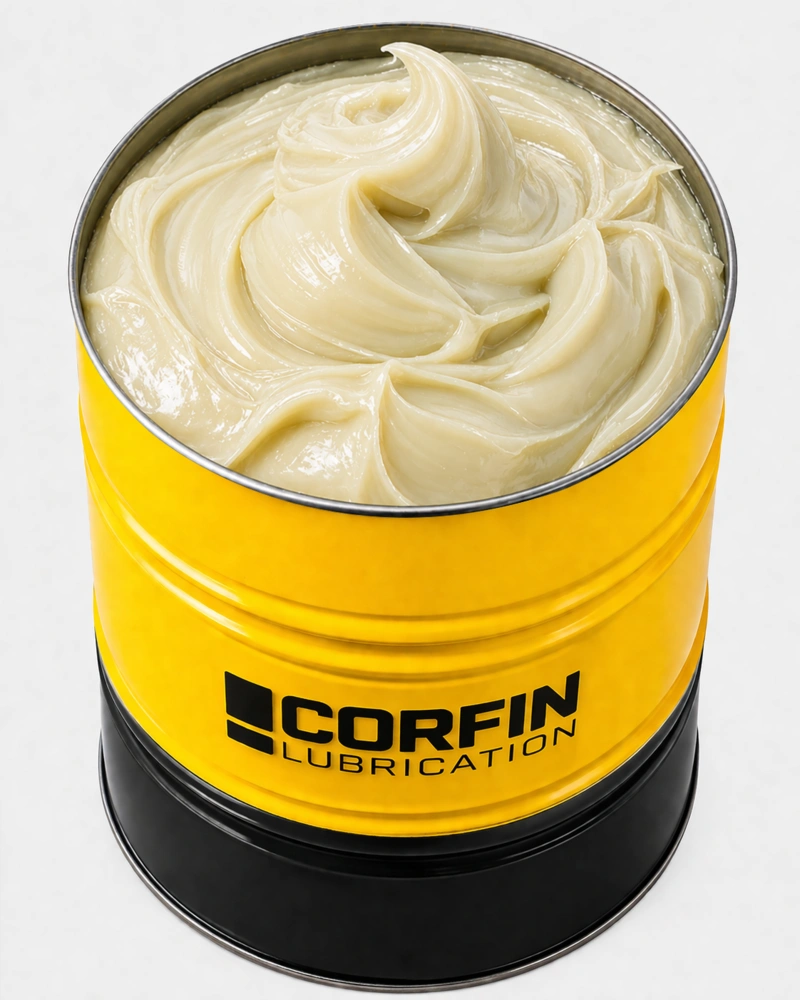
Industrial Greases

Synthetic High-Speed Bearing Grease UNIFLEX 15

Corfin Lubrication brand Unifex 15 high speed grease is produced using synthetic hydrocarbons, esters and barium complex compounds to ensure high performance. It is an ideal lubricating grease for the lubrication of needle roller bearings.

  • Offers a wide operating temperature range of 40 / 130 °C
  • It shows very good working stability even in chemical environments.
  • It is perfectly compatible with plastic and elastomer materials.
Product Categories Industrial Greases
Product Sectors Textiles
Contact

High Speed Grease Advantages

Unifex 15 provides maximum protection against corrosion and wear. It is also a product that is resistant to water, chemical environments and oxidation. Due to its high pumpability, high speed bearing grease supports the uninterrupted operation of machines in centralized lubrication systems.

Unifex 15 has been developed as a complete high speed grease. Thanks to its complex structure, barium does not lose its absorption capacity even at high pressures. It is mostly preferred in needle bearings and high-speed plain bearings.

It is used in CNC lathe head bearings because it operates smoothly even at high speeds. Since high speed grease does not lose its protective properties against cutting fluids, it is frequently preferred in applications where there is a risk of liquid splashing on the bearings.

High Speed Grease Features

  • Offers a wide operating temperature range of 40 / 130 °C
  • It shows very good working stability even in chemical environments.
  • It is perfectly compatible with plastic and elastomer materials.
  • Unifex 15 is truly a high speed grease.
  • It provides maximum resistance to factors such as abrasion and corrosion.

High Speed Grease Usage Areas

It is used in all bearings and bearing housings that need special engineering services and have to work under aggressive conditions.

It is used in all high-speed systems where needle roller bearings operate.

High speed grease is used in sleeve bearings in the textile industry and in all bearings operating at high speed and high temperature.

High speed grease is preferred in all high-speed CNC mirror bearings where the risk of contact with cutting fluids is high.

Technical Specifications

The technical specifications of UNIFLEX 15 grease, based on laboratory test results, are listed below. All values were measured under standard test conditions.

 ANALİZLER  STANDART  BİRİM  SONUÇ
Color     Beige
Appearance     Homogeneous
Thickener     Barium Complex
Base Oil     Ester + SHC
Base Oil Viscosity (cst) at 40 °C ASTM D445 cst 15
Temperature Range   °C -40 / 130
NLGI Class     2
Penetration ASTM D217 mm/10 265 – 295
Dropping Point ASTM D2265 °C > 240
Seperation from Oil (% weight)30 hours / 100 °C ASTM D6184 %wt % 9,00
Seperation from Oil (% weight) 7 days / 40 °C IP 121 %wt 0,91
Four Ball Test 1 hour /75 °C – 40kg (392 N) ASTM D2266 mm 0,65
Four-Ball EP Test 10 sec. / 1770 rpm Speed ASTM D2596 kg > 250
Water Spray (% weight) ASTM D4049 %wt %25
Rust Test ASTM D1743   Pass

Application Areas

It is used in all bearings and housings that require specialized engineering services and must operate under harsh conditions.

High Speed Grease Frequently Asked Questions

Conventional greases cannot work effectively at high speeds. As speed increases, assemblies become hot and standard grease can be expelled, eventually causing the equipment to break. High-speed greases are formulated with special thickeners and oils that allow the oil to maintain its functionality while maintaining the sealing properties required in such mechanisms. One of the parameters to be taken into consideration is the speed factor. The NDm of the bearing to be lubricated is expressed as follows. N = speed limit of the bearing in rpm and Dm = median diameter of the bearing in mm. Often these greases have properties that allow them to reduce noise from bearings at these high speeds (low noise greases). Thus, they guarantee appropriate use to the end consumer. High-speed greases show a special rheological behavior: they become liquid under shear and provide lubrication close to that of an oil. When not moved, they return to their consistency and guarantee tightness. These strong thixotropic events are provided by the thickener. Lithium greases with low soap or even higher polyurea content are best suited to these speed restrictions. Control of the production process to deliver highly thixotropic greases with low noise. Base oils of low viscosity (10 to 100 cSt) and usually of synthetic origin (PAO, synthetic esters). Use of friction modifiers and antioxidant combinations for minimum wear and optimized service life.
 

The most important physical property of a lubricant is viscosity. Viscosity is what determines how thick or thin the lubricating film will be depending on load, speed and surfaces in contact. This should suit the needs of the bearing bed. Most general-purpose greases have a base oil viscosity of approximately 220 centistokes. While this type of grease can work well at moderate speeds and loads, when bearing speed increases the viscosity must be reduced accordingly. There are many ways to calculate viscosity. Using the speed factor mentioned previously, you can use standardized charts to determine the appropriate viscosity for the bearing at operating temperature.
 

Speed factor is a term that helps describe the relationship between the rotational speed of a bearing and the size of the bearing. There are two main ways to calculate this factor. The first is known as the DN value, which uses the inner diameter of the bearing multiplied by the rotational speed. The second method is known as NDm value. This uses the bearing’s median size, also known as pitch diameter, and rotational speed to calculate the speed factor. The speed factor can help you determine various lubricant properties that you can use to select the appropriate lubricant. These properties include the viscosity of the oil and the National Lubricating Grease Institute (NLGI) grade of the grease for the application.
 

Base Oil Viscosity – Make sure the viscosity provides enough lubricating film but not so thick that it causes excessive heat and friction. Channeling Features – Must be able to direct grease in such a way that excessive heat is not generated from grease agitation. Dropping Point – The dropping point of the grease should exceed the operating temperature by a wide margin to prevent excessive leakage and possible bearing failure. Thickener Type – Choose a thickener that can provide proper dropping point, channeling and leakage properties. Also, if you use more than one grease, check the compatibility of thickener types in case of accidental mixing. NLGI Grade – The consistency of the grease will have an impact on the flow properties and channeling properties of the finished lubricating grease. Additive Load – Many applications require additives to improve the performance of the grease. A wide variety of chemical and solid additives can be mixed for greases to aid film strength and reduce friction and wear.


Related Products

Download Technical Documents

Please fill in your details to access the TDS and SDS files.

    Thank you! You can download the files below.