Industrial Greases

Synthetic Heavy-Duty Bearing Grease ZERAX 5502

There are many benefits of using Zerax 5502 synthetic grease. One of the most important of these is its excellent performance at low temperatures as well as at high temperatures. When it returns to the room temperature after minimum or maximum heat degrees, it continues to continue its duty without losing anything from its superior performance and originality.

  • They show full durability in high pressure environments.
  • Resistant to many chemicals and water types
  • It is highly resistant to oxidation and aging.
Packaging 1 kg, 20 kg, 200 kg
Base Oils Synthetic
Thickeners Calcium Sulfonate Complex
NLGI Classifications 1, 2
Product Categories Industrial Greases
Product Sectors Mining - Cement
Contact

Advantages of Synthetic Heavy-Duty Bearing Grease

Zerax 5502 synthetic grease has much lower friction and higher load carrying properties compared to the properties of ordinary petroleum base oils. At the same time, it offers long-term operating performance even when operated over wide temperature ranges. In this way, it is seen as a product that can be safely preferred even at very high or very low temperatures.

Even if large amounts of water are mixed into the synthetic grease, there is no loss of consistency. Due to the nature of the calcium sulfonates it contains, it shows excellent oxidation and corrosion resistance even in the presence of seawater.

Properties of Synthetic Heavy-Duty Bearing Grease

  • Synthetic grease has a wide operating temperature range.
  • It is a product with high pumpability.
  • Extra resistant against rust and corrosion.
  • Retention feature is at maximum level.
  • The cost of synthetic grease is much lower than standard greases due to the long life of the lubrication periods.

Applications of Synthetic Heavy-Duty Bearing Grease

It is suitable for use in rotary kilns and machine bearings in the cement industry where dense dust and high temperatures are present.

Synthetic grease is preferred in many different areas in the maritime industry.

Since it performs flawlessly in difficult conditions, it is used in the conveyor bearings of the moving belts in these areas.

It is preferred in all bearings and bearing housings in machines operating at high and low temperatures.

Application Areas

Synthetic Heavy-Duty Bearing Grease; used in applications such as cement production, marine equipment, mobile concrete mixers, and machinery operating under high and low temperatures.

Technical Specifications

The technical specifications of ZERAX 5502 grease, based on laboratory test results, are listed below. All values were measured under standard test conditions.

 ANALİZLER  STANDART  BİRİM  SONUÇ
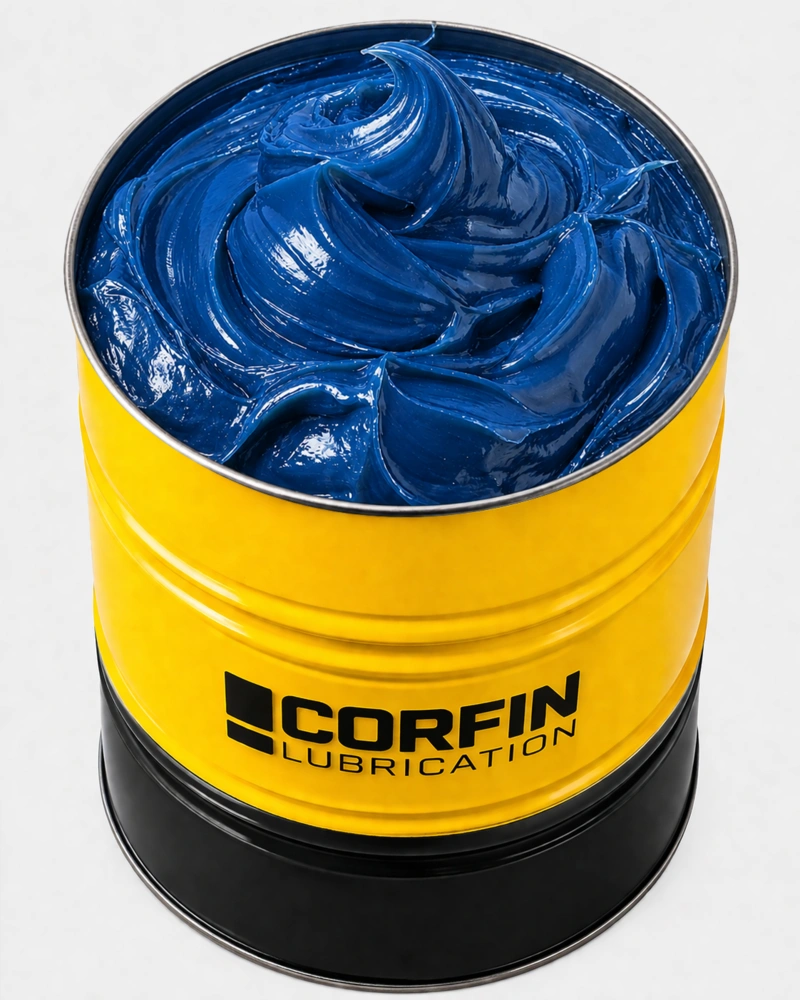
Color     Blue
Appearance     Homogeneous
Thickener     Calcium Sulfonate Complex
Base Oil     Synthetic
Base Oil Viscosity (cst) at 40 °C ASTM D445 cst 460
Temperature Range   °C -40 / 205
NLGI Class     1 / 2
Dropping Point ASTM D2265 °C >320
Seperation from Oil (% weight) 30 hours / 100 °C ASTM D6184 %wt %3,70
Copper Corrosion (100 °C – 24 hours) ASTM D130 Max 1 b 1 a
Four Ball EP Test 10 sec. / 1770 rpm Speed (kg) ASTM D2596 Kg > 400
Four Ball Test 1 h./1200 rpm Speed, 40kg (392N) ASTM D2266 mm 0,5
Water Spray (% weight) ASTM D4049 %wt %15
Rust Test ASTM D1743   Pass

Frequently Asked Questions About Synthetic Heavy-Duty Bearing Grease

Viscosity: A measure of a lubricating oil’s resistance to flow. Viscosity index: Defined as the rate of change of viscosity with respect to temperature. Importance: It is the most important property determining the performance of lubricating oils under the influence of temperature. A lubricating oil must have sufficient viscosity to maintain a lubricating film on the surface. For machine parts moving at low speeds under high pressures, a high viscosity oil should be used as it is more resistant to squeezing out between rubbing parts. For lower pressures and high speeds, lighter oils can be used. If the viscosity is too low, it is not possible to form a liquid oil film between two moving or sliding surfaces, resulting in excessive wear.
 

Unlike oils, greases cannot distribute heat by convection, resulting in faster oxidation or carbonization. At high temperatures, normal grease can soften and flow, form crusts or harden, causing improper lubrication. In practice, high temperature greases may be recommended for processes where the hourly temperature is above 1200C. Selection of a high temperature grease for an application includes the following: 1. Definition of the temperature interval 2. Lubrication intervals 3. Cooling cycles during operation 4. Oil spillage to another component during operation 5. Atmospheric pollution 6. Dropping point of the grease 7. Type, viscosity and viscosity index of the base oil 8. Type of thickener 9. Composition and properties of additives 10. Loading speed 11. Possibility of atmospheric contamination Energy, corrugated cardboard and paper, mines, steel production, pellet mills, tires, hot rolling, automotive paint shops, furnaces in the food and pharmaceutical processing industries are some industries that typically require high temperature grease.
 

Motor bearings are subjected to high radial and low axial loads, but the loads can fluctuate due to the frequent start-up and shutdown depending its operation. Due to its intermittent operation, the friction zones in the motor bearing will constantly shift. With each on/off cycle, the motor starts from zero and reaches its rated speed. As a result, the friction partners experience maximum friction during boundary lubrication and move into the low-friction hydrodynamic zone. High temperatures and extreme vibration are other operational variables that grease must deal with. The grease releases some oil to create the required lubricating film between the friction surfaces. The intense heat generated during the boundary and mixed friction zone can cause the base oil to evaporate and the base oil viscosity to drop. The process continues for the designed life of the grease and the specified relubrication interval. However, in some cases, if the sealing is not effective, the bearings are exposed to external anomalies such as excessive dust, heat, water or corrosive process environment, etc. Also, when the motor is stopped unplanned for long periods of time, the oxidation process accelerates. Bearing metal act as catalysts for the external dust influence, operating temperature, wear particles and the oxidation process. The end result of this oxidation process during prolonged stopping can lead to hardening of the grease or ‘hard cake-like formation’, which can damage bearing life.
 

Sudden hardening, softening or severe discoloration of the grease can be a good indicator to check the grease. Observations can be confirmed with multiple tests to analyze the quality of the grease. A combination of the following tests can help to reach a conclusion. a) Penetration test b) Dropping point test c) IR test in comparison with unused sample d) Four ball anti-wear test e) Wear analysis.


Related Products

Download Technical Documents

Please fill in your details to access the TDS and SDS files.

    Thank you! You can download the files below.